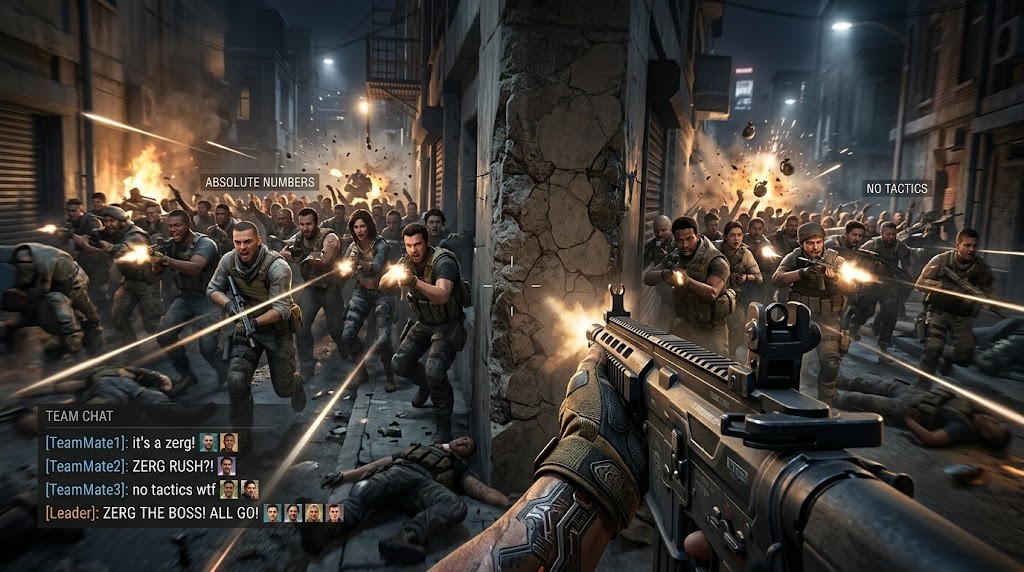
Back in 1998, this word meant something completely different.
How It Took Over Gaming
It started as a StarCraft race and became a verb. Now it describes any situation where quantity beats quality. Six players rushing one guy in Warzone, your entire team collapsing on A site with no plan, or even real life when your group chat blows up while you’re asleep.
The term escaped RTS games long ago. MOBA players use it when five people dive one underfed support. Battle royale players use it when a full squad third-parties a fight. If you’re outnumbered and confused, you just got hit by it. Even a smurf can get overwhelmed by sheer numbers.
What makes it stick is the imagery. You picture a swarm. Dozens of cheap units flooding over a base, or a Discord call with eight people talking at once. It’s chaos, but organized chaos. The kind of play that makes toxic teammates yell in voice chat. The kind that wins through volume, not skill.
The word also carries a hint of desperation. Doing this implies you don’t have a better plan. You’re throwing bodies at the problem and hoping it works. Sometimes it does. Usually it doesn’t. But it’s never boring.
Real Conversations
Ranked, minute 3:
Classic.
Sometimes it’s the strategy. Other times it’s the absence of one. The difference is whether it works.
In modern gaming, the word has softened into a catch-all for any group rush. But purists, mostly old-school StarCraft players who’ve been around since before noob was an insult, will correct you. “That’s not a zerg, that’s just a push.” They remember when the term meant something specific: six Zerglings at your base before you built your first marine.
Where It Came From
The Zerg were one of three playable races in Blizzard’s StarCraft, released in 1998. Their whole deal was swarming. Cheap, fast units called Zerglings that could overwhelm opponents before they built defenses. Korean players perfected the “Zergling rush,” winning games in under five minutes.
By the early 2000s, it had become gaming shorthand for any numbers-based rush. The term hit mainstream culture in 2012 when Google made a Zerg Rush Easter egg. Search it and little O’s would eat your results. That’s when you know a gaming term has made it.
The word’s longevity comes from its flexibility. It works in any game with teams. It works in MMOs, battle royales, even tabletop RPGs. And unlike a lot of gaming slang, it’s actually useful as tactical vocabulary. Callout: “they’re zerging B.” Everyone knows what you mean.
FAQ
Is this the same as rushing or pushing?
Kinda, but all three are different. Here’s how to tell:
| Zerg | Rush | Push |
|---|---|---|
| About numbers | About speed | About coordination |
| No plan needed | Timing matters | Teamwork required |
| “Everyone go” | “Go fast” | “Go together” |
| Can work by accident | Needs execution | Needs communication |
Do pros actually do it?
In organized play? Rarely. Pro teams coordinate picks and crossfires. This is what happens when coordination breaks down and someone yells “just go.” You’ll see it in ranked, not at CS2 Majors.
How do I explain it to a non-gamer?
Tell them it’s sending twenty people to do a five-person job. No strategy, just bodies. Like when your entire family shows up to help you move but nobody knows what they’re carrying.