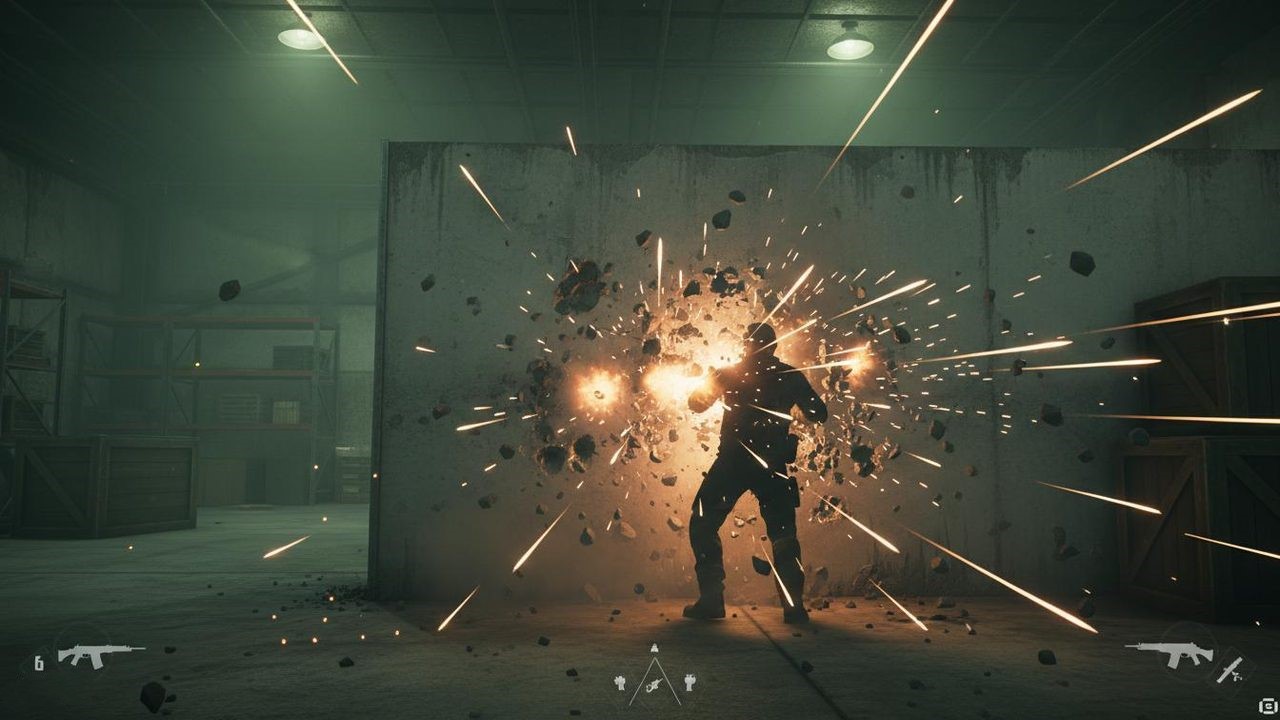
In gaming, “wallbang” means killing an enemy by shooting through a wall or other solid surface. It’s one of the most satisfying plays in tactical shooters, requiring deep map knowledge and precise positioning.
High-Fidelity Contextual Dialogues
Scene: CS2, after a wallbang kill
Player A: “Did you see that wallbang?!” Teammate: “Through double doors?! How did you know he was there?” Player A: “I heard him shift-walking. 2000 hours of map knowledge paying off.” Teammate: “That’s the cleanest wallbang I’ve ever seen” Player B: “Teach me your ways, wallbang sensei”
Scene: Discord, showing a clip
Alex: “Check this wallbang I hit yesterday” Jordan: “You shot through a WALL and got a headshot?” Alex: “The AK penetrates that wall perfectly. I pre-aimed the common angle.” Jordan: “That’s not luck, that’s pure game sense” Alex: “Wallbangs are 90% knowledge, 10% guessing. I knew he’d be there.”
Scene: Twitch chat, pro player wallbang highlight
[Pro player gets a wallbang through smoke AND a wall] Chat: “WALLBANG THROUGH SMOKE” Chat: “that’s illegal” Chat: “how does he even know” Chat: “game sense lvl 999” Caster: “And THAT is why he’s the best in the world. You can’t teach that kind of map awareness.”
Trajectory & Chronology
The term “wallbang” originated in Counter-Strike (1999), where certain weapons could penetrate thin walls and doors, allowing skilled players to kill enemies without direct line of sight. By the early 2000s, “wallbang” was standard CS terminology, with competitive players memorizing penetration points on every map. The mechanic spread to other tactical shooters: Rainbow Six Siege made wall destruction central to gameplay (literally shooting through walls is the game’s defining feature), while VALORANT incorporated wallbangs through specific agent abilities and weapon penetrations. Call of Duty adopted wallbangs with the “FMJ” (Full Metal Jacket) attachment that increases bullet penetration. In 2026, wallbangs remain a signature skill expression in tactical shooters — getting a kill through a wall demonstrates not just aim, but deep game knowledge that casual players don’t possess.
GEBILAOWANG: A wallbang isn’t just a kill — it’s a statement. It says “I know this map better than you know your own bedroom.” There’s something deeply satisfying about killing someone who thought they were safe behind a wall.
Socio-Cultural Gain
Wallbang represents the peak of game knowledge in tactical shooters — the moment when map memorization and prediction pay off in the most dramatic way possible. Unlike flashy flick shots (which anyone can appreciate), wallbangs are understood primarily by experienced players who know the maps well enough to recognize what just happened. This creates a unique social dynamic: when a pro player hits a wallbang, casual viewers might not understand the skill involved, while experienced players lose their minds. “Knowing your wallbangs” has become a shorthand for having deep game knowledge — it’s the difference between someone who plays casually and someone who studies the game. In esports, wallbang kills are among the most hype moments, often generating the loudest crowd reactions. The term has also spawned “wallbang spots” — specific locations on maps that are known penetration points, which competitive teams practice extensively.
FAQ
Q1: Can you wallbang through any wall in every game?
No. Wall penetration depends entirely on the game. Counter-Strike has specific penetrable surfaces (thin walls, doors, wooden boxes) while thick concrete walls block bullets. Rainbow Six Siege lets you shoot through almost everything. VALORANT has limited penetration that varies by weapon. Call of Duty’s penetration depends on the FMJ attachment. Battle royale games generally have minimal wall penetration. You need to learn each game’s specific penetration mechanics — there’s no universal rule.
Q2: How do pros know where to wallbang?
Thousands of hours of practice and map study. Pros memorize common player positions, popular angles, and movement timings. They also use sound cues — footsteps, reloads, and ability usage reveal enemy positions through walls. In team games, callouts from teammates provide target locations. Some wallbangs are pre-fires (shooting before you see the enemy based on predicted timing). It’s not guessing — it’s applied knowledge from extensive experience.
Q3: Is wallbanging still a major skill in 2026?
Yes, particularly in tactical shooters. CS2 and VALORANT both maintain wall penetration as a core mechanic, and professional players are expected to know standard wallbang spots. Rainbow Six Siege has made wall destruction even more central to gameplay. However, battle royale games have generally moved away from wall penetration, focusing more on building/editing mechanics instead. Wallbangs remain one of the most respected skill expressions in competitive FPS.
Q4: How do I explain wallbang to a non-gamer in one sentence?
“In shooting games, a ‘wallbang’ is when you kill someone by shooting through a wall — it requires knowing exactly where the enemy is standing based on sound cues, map knowledge, and prediction, making it one of the most impressive plays in competitive gaming.”