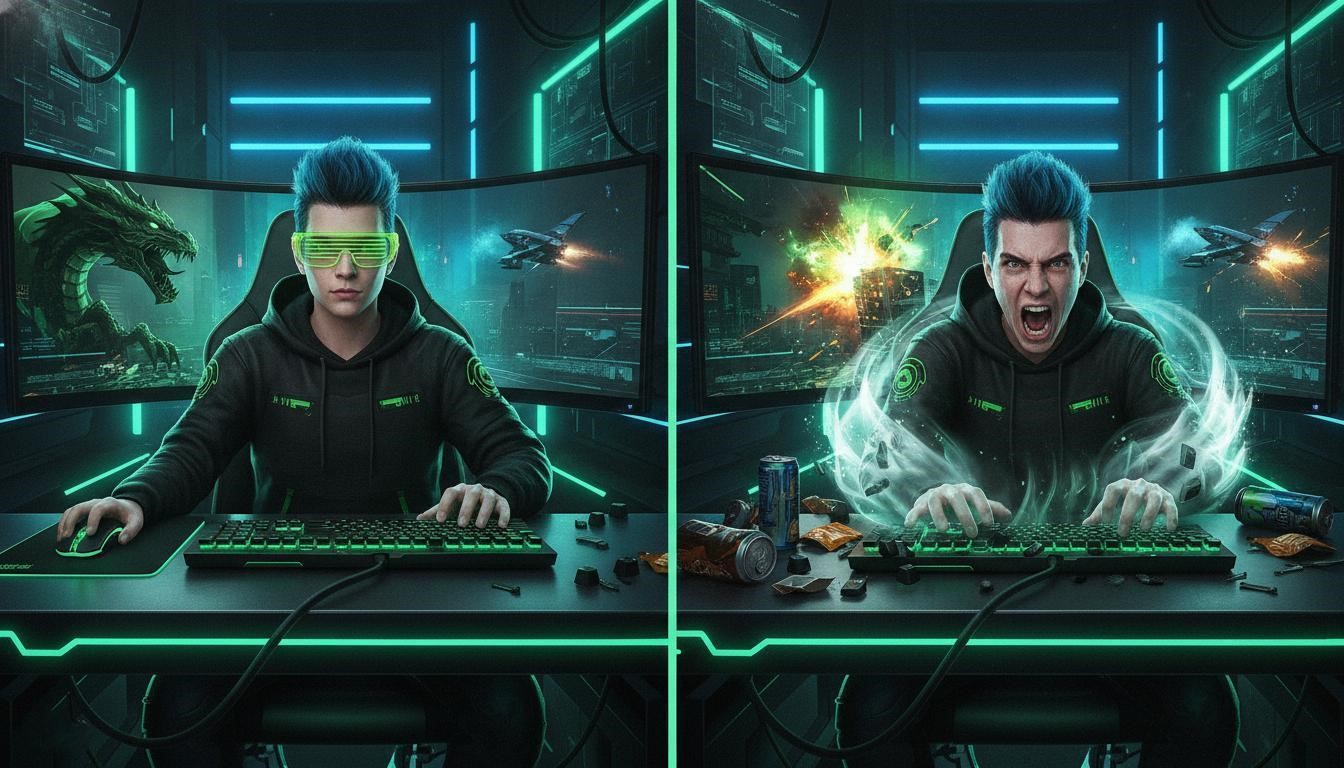
“Tweaking” in gaming describes that spiral where stress, panic, or over-excitement takes over and your gameplay completely falls apart. You’re not just playing badly — you’re playing erratically. Fidgety. Jittery. Making decisions that make no sense because your brain is running on pure adrenaline instead of logic.
Trajectory & Chronology
The term “tweaking” comes from urban/street slang in the early 2000s, where it described someone acting erratically — jittery, unfocused, scattered — often associated with stimulant use. The gaming community adopted the term around 2018-2020, stripping the drug connotation and applying it to the physical and mental state of panicked gameplay. Streaming culture accelerated its spread, with streamers visibly tweaking on camera — shaky aim, impulsive decisions, rapid-fire talking — giving viewers a perfect visual reference for the term. By 2021, “tweaking” had become standard vocabulary across competitive gaming, particularly in FPS titles where the physical symptoms (shaky aim, erratic movement) are most visible. The term gained further popularity through esports broadcasts, where commentators use it to describe players who lose composure under pressure. In 2026, “tweaking” describes a universal gaming experience — the moment when your mental state sabotages your mechanical skill. It’s one of the most relatable terms in gaming because literally everyone has experienced it.
GEBILAOWANG: Everyone tweaks. Even pros. The difference is recognizing it and having strategies to manage it.
High-Fidelity Contextual Dialogues
Scene: Valorant, mid-match meltdown
Player A: “I’m tweaking right now, I can’t hit anything.” Player B: “Breathe. You missed one shot.” Player A: “I missed twelve shots. I peeked the same angle three times. I’m tweaking.” Player B: “Okay, you’re tweaking. Sit this round out, let me entry.”
Scene: Observing a tilted teammate
Player A: “Our entry is tweaking, he’s peeking everything.” Player B: “He died to the same guy twice and now he’s hunting him.” Player A: “Classic revenge tweak. Should we say something?” Player B: “Never tell a tweaking player they’re tweaking. It makes them tweak harder.”
Scene: Post-round honesty
Player A: “I was tweaking that whole game. My hands wouldn’t stop shaking.” Player B: “What caused it?” Player A: “Overtime, 1v2 clutch situation. The pressure got to me.” Player B: “You still won the clutch though.” Player A: “Pure luck. My crosshair was everywhere except the enemy.”
Scene: Commentating on a stream
Viewer 1: “This player is tweaking under the pressure.” Viewer 2: “How can you tell?” Viewer 1: “He’s reloading after every shot. He’s using abilities at the wrong time. He’s talking twice as fast in comms.” Viewer 2: “Those are the signs?” Viewer 1: “Those are the signs. Dude is fully tweaked.”
Scene: Self-awareness during a session
Player A: “I think I’m starting to tweak. My sens feels weird.” Player B: “That’s the first sign. Take a break?” Player A: “Five more minutes.” Player B: “You said that twenty minutes ago and you’ve died to the same angle four times.” Player A: “…okay. Break time.”
Socio-Cultural Gain
“Tweaking” represents one of gaming culture’s most honest admissions: that our bodies and minds sometimes betray us under pressure. Unlike “tilt” (anger-driven poor play), tweaking is panic-driven — it comes from caring too much, wanting too badly, or being too wired. This distinction is culturally significant because it frames tweaking as a vulnerability rather than a flaw. Admitting you’re tweaking is a form of emotional honesty that’s relatively rare in competitive gaming’s “always be clutch” culture.
The term has become a tool for self-regulation and team communication. Saying “I’m tweaking” is both an acknowledgment of poor performance and a request for patience — it’s gaming’s equivalent of “I’m not at my best right now.” This linguistic shortcut helps teams navigate difficult moments without the blame and defensiveness that usually accompany poor play. Streamers and content creators have normalized discussing tweaking openly, helping reduce the stigma around performance anxiety. The term also bridges gaming and broader mental health conversations, providing accessible language for discussing stress responses. “I’m tweaking” is easier to say than “I’m experiencing an acute stress response that’s impairing my fine motor skills” — and everyone knows exactly what you mean.
Tilt — Similar but more anger-focused. Choking — Underperforming in clutch moments. Shaky — Physical manifestation of tweaking.
FAQ
Q1: How do I stop tweaking mid-game?
A: Take deliberate deep breaths between rounds. Lower your mouse sensitivity temporarily. Sit back physically from the screen. Drink water to counteract dehydration and caffeine. If possible, let someone else take aggressive roles for a round. The key is breaking the adrenaline loop — any physical action that forces you to pause and reset helps.
Q2: What’s the difference between tweaking and tilting?
A: Tilt is anger-driven — you’re mad, frustrated, making aggressive plays out of spite. Tweaking is panic-driven — you’re jittery, unfocused, making erratic plays out of stress. Tilt makes you aggressive; tweaking makes you erratic. Tilt recovers slowly (you need to calm down); tweaking can be fixed with a breath and a reset. They’re related but distinct states.
Q3: Do professional players tweak?
A: Constantly. Even the best players in the world experience tweaking — it’s a human stress response, not a skill issue. The difference is that pros have trained themselves to recognize the signs (shaky aim, impulsive decisions) and have specific protocols to manage it. Some pros take micro-breaks between rounds. Others have breathing exercises. The best pros treat tweaking management as a skill to develop, not a weakness to hide.