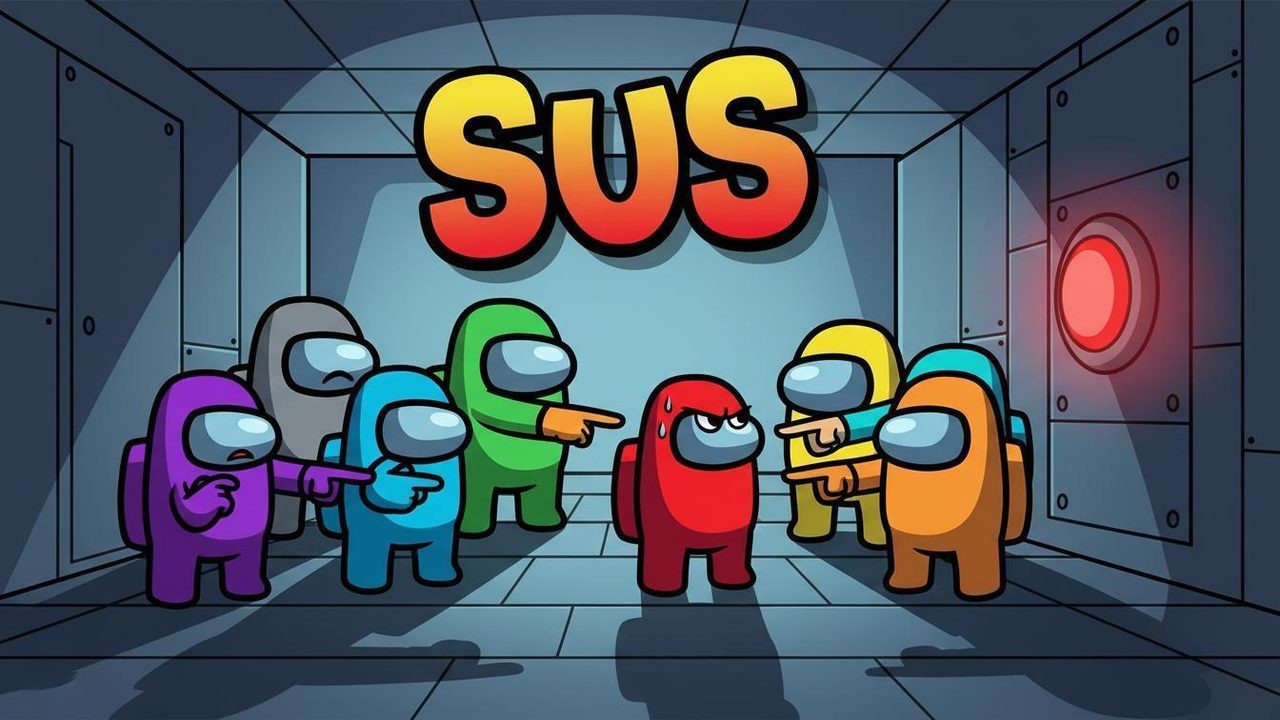
In gaming, ‘sus’ is short for ‘suspicious’ and describes someone acting shady, untrustworthy, or deceitful. Popularized by Among Us in 2020, it has become a universal gaming term for calling out questionable behavior.
Trajectory & Chronology
The rise of ‘sus’ coincided with the explosive popularity of Among Us in 2020, making it a marker of that era’s pandemic gaming culture. While ‘sus’ existed as slang long before Among Us — shortening ‘suspicious’ has been common in urban communities since the early 2000s — the game transformed it from niche slang into a global phenomenon. In Among Us, players call each other ‘sus’ when they suspect someone is the hidden impostor. The term’s brevity made it perfect for the game’s quick accusation mechanics: ‘Red sus’ or ’that’s sus’ became the default way to cast suspicion. By late 2020, ‘sus’ had transcended gaming entirely, entering mainstream vocabulary through TikTok, Twitter, and even political discourse. The term’s peak popularity came in 2020-2021 when Among Us dominated streaming platforms. In 2026, ‘sus’ remains common in gaming, though its mainstream usage has declined. Within gaming communities, it has returned to its original purpose: describing genuinely suspicious behavior.
GEBILAOWANG: ‘Sus’ had a moment where politicians were saying it, which is usually when a slang term officially dies. But gamers kept it alive.
Socio-Cultural Gain
Sus represents how a single game can catapult niche slang into global consciousness. Before Among Us, ‘sus’ was primarily used in AAVE (African American Vernacular English) and certain regional dialects. After Among Us, it was being said by 8-year-olds and 80-year-olds alike. This rapid mainstreaming created a unique cultural tension — the original communities who used ‘sus’ felt their language was being co-opted, while gamers celebrated their role in spreading it. The term also reveals how social deduction games create their own vocabulary. ‘Sus,’ ‘vent,’ ’task,’ ’emergency meeting’ — Among Us generated an entire lexicon that players adopted instantly. The simplicity of ‘sus’ is its genius: two letters and one syllable to express doubt, accusation, and wariness all at once. Even as Among Us’s popularity has faded, ‘sus’ persists because it fills a genuine communication need — there’s no shorter way to say ‘I don’t trust you.’
High-Fidelity Contextual Dialogues
Scene: Among Us lobby, emergency meeting
Red: “I saw Blue vent in Electrical” Blue: “No I didn’t, I was doing wires” Green: “That’s sus, Blue. Wires are in Electrical but you weren’t there when I checked” Blue: “I’m telling the truth!” Cyan: “Blue is acting mad sus right now”
Scene: Twitch chat, streamer makes a questionable play
Streamer: “I’m definitely not the impostor, trust me” Chat: “sus” Chat: “sus behavior” Chat: “the more they say trust me the more sus it is” Chat: “classic sus defense” Streamer: “Chat please, I’m crew this round”
Scene: Discord, friend group playing social deduction
Alex: “Why did you follow me into that room?” Jordan: “I was just exploring” Marcus: “That’s sus, you always follow people when you’re the killer” Jordan: “I’m not the killer this time, I swear” Alex: “The swearing makes it more sus honestly”
FAQ
Q3: Is ‘sus’ still used in 2026?
Yes, though less in mainstream non-gaming contexts. Within gaming communities, ‘sus’ remains standard vocabulary for social deduction games and any situation involving deception. Its mainstream popularity peaked in 2020-2021 and has since declined, but gamers never stopped using it.
Q1: Did ‘sus’ come from Among Us?
No — Among Us popularized it globally, but ‘sus’ existed as slang for ‘suspicious’ long before the game, primarily in AAVE and urban communities since the early 2000s. Among Us took an existing slang term and gave it worldwide recognition.
Q2: Is calling someone ‘sus’ an accusation?
Context-dependent. In social deduction games (Among Us, Werewolf, Mafia), calling someone ‘sus’ is a direct gameplay accusation. In casual conversation, it’s usually lighthearted teasing about suspicious behavior. In serious contexts, it can be genuinely accusatory.
Q4: How do I explain ‘sus’ to a non-gamer in one sentence?
“It’s short for ‘suspicious’ — when someone is acting shady or untrustworthy, you say they’re ‘sus.’ It became famous through a game called Among Us where players accuse each other of being the impostor.”