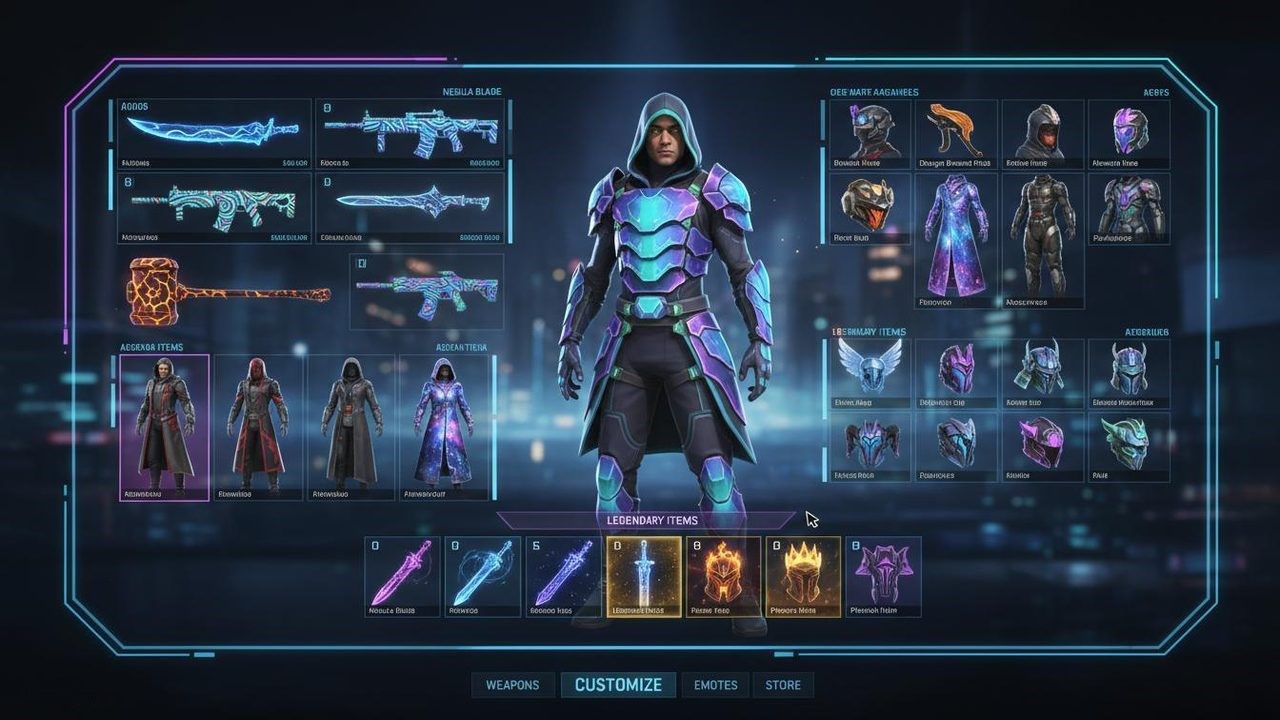
In gaming, a skin is a cosmetic item that changes the appearance of a character, weapon, or item. Purely visual, no gameplay advantage.
Trajectory & Chronology
Skins originated in Counter-Strike 1.6 (2003) with custom player models, but the modern skin economy was born with Team Fortress 2 (2007) and Counter-Strike: Global Offensive (2012). Valve’s weapon cases and the Steam Marketplace created a billion-dollar virtual economy. Fortnite (2017) popularized the Battle Pass model, where skins are the primary reward. By 2026, skins are the main monetization method for free-to-play games, with some rare skins selling for thousands of dollars.
GEBILAOWANG: Skins are the most genius monetization in gaming history — people pay real money for pixels that don’t affect gameplay.
High-Fidelity Contextual Dialogues
Scene: Pre-match lobby
Player A: “Check out my new legendary skin” Player B: “How much did that cost?” Player A: “Too much, don’t ask”
Scene: In-game
Player A: “That skin is so distracting, I can’t see anything” Player B: “That’s why I bought it, psychological warfare”
Scene: Trading
Player A: “I’ll trade you my Dragon Lore for your knife” Player B: “No way, the knife is worth way more”
Socio-Cultural Gain
Skins have transformed gaming from a product into a platform. What started as cosmetic additions has become a multi-billion dollar economy, with rare skins selling for thousands of dollars. The concept of ‘skin culture’ — where your cosmetic choices signal identity, status, and personality — is unique to gaming. Controversies around gambling-like mechanics (loot boxes) have led to regulation in several countries. In 2026, skins remain the primary monetization model for free-to-play games.
FAQ
Q1: Do skins affect gameplay?
Officially no, but some claim certain skins have better ‘feel’ or sound cues.
Q2: Why are skins so expensive?
Rarity, demand, and the gambling aspect of loot boxes drive prices up.
Q3: Can you make money from skins?
Yes, trading and selling rare skins can be profitable, but it’s risky.