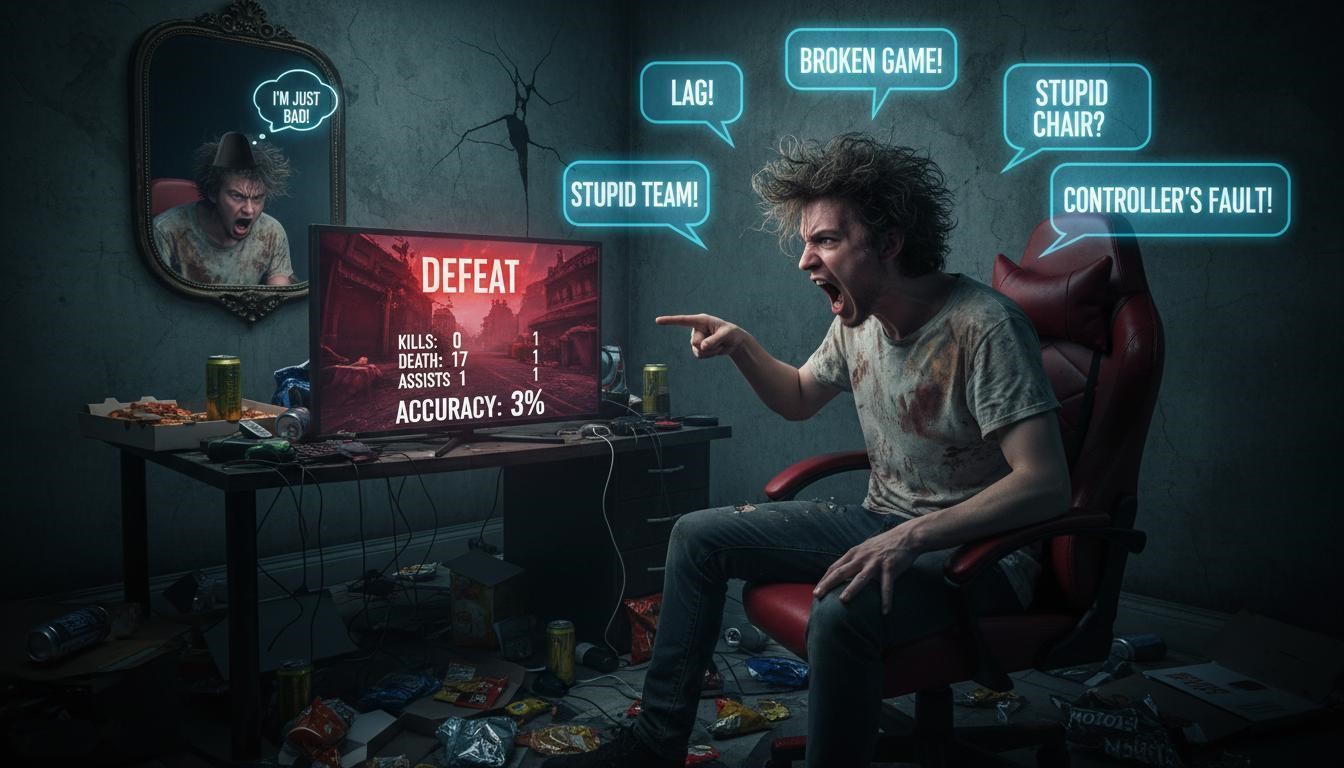
A scrub is a bad player who makes excuses instead of improving. They’re the person who blames the game, the lag, the “broken” character — anything except their own lack of skill. Being called a scrub is the gaming equivalent of being told you have a bad attitude.
FAQ
Q: What’s the difference between a “scrub” and a “noob”?
“Noob” (newbie) refers to a new player — low skill level but willing to learn. “Scrub” refers to someone with an attitude problem — their skill might not be low, but they refuse to take responsibility for their failures. Noob is a phase everyone goes through. Scrub is a mindset some people never escape. Being called a noob isn’t shameful; being called a scrub is a warning.
Q: Is being called a “scrub” a serious insult?
It depends on context. Among strangers, calling someone a scrub may be seen as toxic. Among friends, it’s playful banter. In competitive communities, it’s part of the culture — admitting you’re being a scrub shows self-awareness, which is the first step to improvement. Constructive “don’t be a scrub” is completely different from malicious “you’re a scrub.”
Q: Is “scrub” still popular in 2026?
Still very popular. The term has been around since the 1990s arcade era with almost no decline. Meanzhub’s 2026 gaming slang guide and Slang.org both include it. Compared to flash-in-the-pan slang, scrub describes an eternal behavior pattern — making excuses instead of improving — giving it tremendous staying power.
Q: How do I explain “scrub” to a non-gamer in one sentence?
“In competitive games, a scrub is someone who isn’t very skilled but refuses to learn and improve. They always make excuses for their failures — blaming unbalanced games, calling opponents’ tactics ‘cheap,’ blaming bad luck — never admitting their own shortcomings.”
Trajectory & Chronology
‘Scrub’ originated in 1990s arcade fighting game culture, where it described inexperienced players who frequented arcades but never improved. The term gained formal definition in David Sirlin’s influential 2002 article “Playing to Win: Becoming the Champion,” where he defined a scrub not just as a bad player, but as someone with a specific mindset: they create arbitrary mental rules about ‘cheap’ tactics to protect their ego. By the late 2000s, ‘scrub’ had spread beyond fighting games into all competitive genres. The rise of ranked matchmaking in the 2010s created the perfect environment for scrub behavior — players who blamed teammates, meta, and luck rather than examining their own play. In 2026, ‘scrub’ appears in Meanzhub’s 2026 gaming slang guide and Slang.org’s dictionary, confirming its enduring status. The term has also softened over time — between friends, ‘scrub’ is often playful banter rather than a serious insult.
GEBILAOWANG: The difference between a noob and a scrub: a noob is new and willing to learn. A scrub has been playing for years and still blames the controller. One is a stage, the other is a lifestyle.
Socio-Cultural Gain
Scrub represents gaming culture’s value system around self-improvement and accountability. The term isn’t just about skill level — it’s about attitude. A diamond-ranked player can be a scrub if they blame teammates for every loss. An iron-ranked player isn’t a scrub if they’re actively trying to improve. This distinction makes ‘scrub’ one of gaming’s most psychologically precise insults. The term also highlights the tension between ‘playing for fun’ and ‘playing to win.’ Scrubs, according to Sirlin’s definition, invent moral frameworks (‘using that weapon is cheap’) to justify their losses. This behavior frustrates competitive players because it rejects the fundamental premise of competition: do whatever it takes within the rules to win. In 2026, ‘scrub’ remains a powerful term because it attacks not someone’s skill, but their mindset — and mindset is harder to change than skill.
High-Fidelity Contextual Dialogues
Scene: Game voice comms, after a loss
Player A: “That character is so broken, no skill required” Teammate: “Dude, they’ve been playing that character for 500 hours. You’re just getting outplayed.” Player A: “No, the character is literally OP” Teammate: “Stop being a scrub and learn the matchup”
Scene: Discord, friend roasting session
Alex: “I can’t believe I lost to that” Jordan: “Because you’re a scrub” Alex: “The game lagged!” Jordan: “Classic scrub excuse. ‘The game lagged,’ ‘my controller died,’ ’the sun was in my eyes’” Alex: “Okay fine, I got outplayed. Happy?” Jordan: “There’s hope for you yet. Admitting it is the first step to not being a scrub.”
Scene: Reddit, competitive advice thread
User1: “How do I stop being a scrub?” User2: “Stop making excuses. Watch your replays. Every death is your fault until proven otherwise.” User3: “A scrub blames the game. A good player blames themselves.” User4: “Also, learn to appreciate when opponents outplay you. Saying ’nice shot’ instead of ’lucky’ changes your whole mindset.”