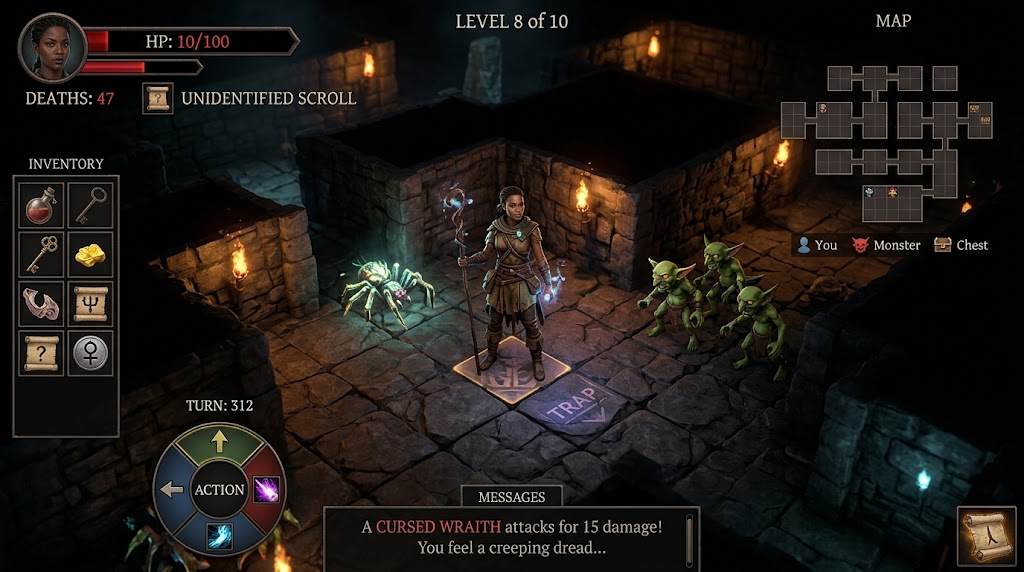
Every new player learns roguelike the hard way. Two hours into a promising run, one greedy step, and the counter resets to zero while the title screen pretends nothing happened. Somehow you queue up again. That’s the genre in one move.
Why Gamers Can’t Quit Roguelike
Because losing is the content. Every death teaches the map, the bosses, the RNG moods, and the walk back feels shorter because you’re sharper. Failure became a progression system. Turns out that’s addictive.
The label also mutated. Half the indie scene ships permadeath and procedural rooms stapled on, which ignited the eternal definition fight. Purists wave the 2008 Berlin Interpretation: turn-based, grid, random levels, permadeath. Everyone else just wants to know if Hades counts. (It doesn’t. It’s a roguelite. Fight them, not me.)
| Roguelike | Roguelite | |
|---|---|---|
| Death takes | everything, clean restart | some unlocks carry over |
| Pressure | one mistake snowballs | friendlier to dabblers |
| Typical crowd | NetHack veterans | Hades and Dead Cells fans |
When to Drop a Roguelike
Mostly as a recommendation, a warning, or a flex. A few roguelike examples from real chats.
Run 47. You know the one:
Me: new personal best. floor eight, build fully online Game: here’s a boss you’ve never seen Me: and it’s gone Me: one more
The group chat needs a new obsession:
Teo: is slay the spire actually good or do people just say that Ana: i’m 400 hours in Teo: since when Ana: march. don’t look at me
The weekly definition war on Reddit:
“hades is my favorite roguelike” “roguelite. unlocks carry over. this isn’t hard” “the game is literally hard, that’s the problem”
Co-op Discord, 1 AM:
Jules: if we die here we lose the ember Kev: then don’t die Jules: incredible advice, carving it on my tombstone
Handy shorthand, too. Telling a friend “it’s a roguelike” means: you’ll lose, you’ll git gud, and you’ll thank it.
Before Roguelike Was Everywhere
The roguelike origin dates to 1980: Rogue, built by two students who wanted a dungeon nobody could memorize. Everything was ASCII: you were an @, monsters were capital letters, walls were punctuation. Floors generated fresh each run, death was forever. People lost semesters to a game made of text.
The following two decades grew a family: NetHack, Angband, ADOM, Crawl. Usenet fans needed a name for the pile and landed on “games like Rogue,” then trimmed that down around 1993. It stuck so hard that a 2008 Berlin conference published a formal checklist, the Berlin Interpretation, to end the arguments. It did not end the arguments.
Then the 2010s indie wave took the label mainstream: Spelunky, FTL, Isaac, Dead Cells, a thousand Steam tags. I’ve dropped whole weekends into dungeons drawn in punctuation, so honestly, the popularity tracks. The loot was letters and we loved it.
Common Questions
Roguelike vs roguelite: how do I tell them apart?
Check what death takes. Strict entries wipe you to a clean start after every failed run. If unlocks, currency or story progress carry over, you’re in roguelite territory. What does roguelike mean for your blood pressure? Roughly the same, either way.
When would I recommend one to a friend?
When they like learning systems more than following a story. These games reward pattern recognition and stubbornness. If your friend rages at losing progress, start them on a roguelite first. Ease them in. Then show them NetHack and watch the color leave their face.
Why is everything on Steam suddenly wearing the label?
Because the formula sells and it’s kind to small budgets: procedural levels stretch a tiny team’s work into years of runs. Why do gamers say roguelike about half the indie section now? Marketing, mostly. The purists lost that war around 2015.
What’s the one-sentence pitch for a total outsider?
A board game that reshuffles the board every time you lose, and you will lose. That’s the hook: each attempt makes you better even when the save file doesn’t move an inch.