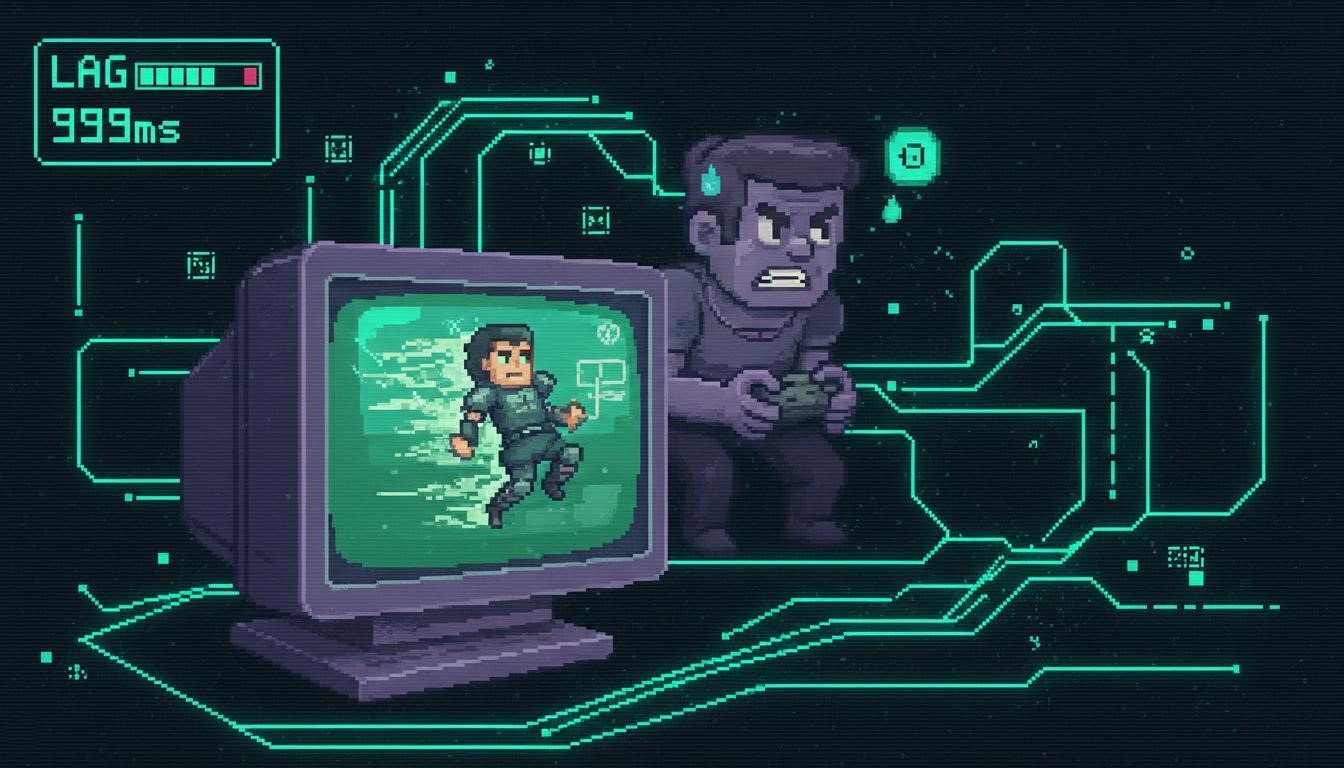
Trajectory & Chronology
The term “ping” predates online gaming by decades. It originated in the early 1980s as a network diagnostic tool created by Mike Muuss, a scientist at the US Army Research Laboratory. The name came from sonar — submarines send out a sound pulse (a “ping”) and measure how long it takes to bounce back, determining the distance to an object. Muuss’s network tool did the same thing: sent a small data packet to a server and measured the round-trip time.
The tool became standard across all internet-connected systems. When online multiplayer gaming emerged in the 1990s (Quake, Counter-Strike, StarCraft), players quickly discovered that their ping number directly affected gameplay quality. A ping of 50ms meant responsive gameplay; a ping of 200ms meant noticeable delay between clicking and seeing the result.
In the 2000s, as broadband internet replaced dial-up, ping became a standard metric displayed in every multiplayer game. Server browsers in Counter-Strike 1.6 showed ping next to every server. Players learned to filter for low-ping servers because high ping put them at a competitive disadvantage. The phrase “lag” became synonymous with high ping, though technically lag can have multiple causes.
By the 2010s, the gaming industry responded to ping concerns in major ways. Riot Games built Riot Direct, a dedicated network infrastructure designed to reduce ping for League of Legends players. Cloud gaming services (Google Stadia, NVIDIA GeForce Now) emerged promising low-latency gameplay. Esports tournaments invested heavily in LAN (Local Area Network) setups specifically to eliminate ping as a competitive variable.
In 2026, ping remains the single most important technical factor in competitive online gaming. Players routinely complain about “ping diff” (ping difference) when they lose — blaming their connection rather than their skill. Some games now display enemy ping in the scoreboard, adding another layer of competitive information. And the ongoing rollout of 5G and fiber internet continues to push average ping numbers lower across the globe.
GEBILAOWANG: Ping is the great equalizer and the great excuse. Good ping lets you show your skill. Bad ping gives you something to blame.
High-Fidelity Contextual Dialogues
Scene: Valorant, player lagging in a clutch
Player1: “I died behind cover, that was bullshit” Player2: “What’s your ping?” Player1: “180ms” Player2: “Bro you’re playing on McDonald’s wifi” Player1: “It’s all I have” Player3: “Ping diff honestly, you would’ve won that with normal ping”
Scene: Discord, choosing a server
Alex: “Which server are we playing on?” Jordan: “US East, I get 30 ping there” Sam: “I get 80 on US East but 40 on US West” Jordan: “But Alex gets 120 on US West” Alex: “Just pick US East, I’ll deal with the ping”
Scene: Twitch chat, streamer checks their ping
Streamer: “Let me check my ping real quick” Opens network overlay Streamer: “12ms, we are CRISP today” Chat: “12ms? are you playing from the server room?” Chat: “I play on 200ms and I’m immortal” Chat: “ping doesn’t matter if you’re good” Streamer: “Chat, ping ALWAYS matters”
Scene: Post-match lobby, analyzing a loss
Player1: “How did he kill me? I was around the corner” Player2: “His ping was 20, yours was 90. On his screen you were still visible” Player1: “So I got peeker’s advantaged?” Player2: “You got ping diff’d. The oldest trick in the book”
Scene: Tech support conversation
Support: “Can you run a speed test?” Player: “My download is 500 Mbps” Support: “That’s great, but what’s your ping to the game server?” Player: “…what’s ping?” Support: “It’s the time it takes for your actions to reach the server. High download speed doesn’t guarantee low ping” Player: “Oh. How do I check?” Support: “Type ‘ping [server IP]’ in command prompt, or just check the in-game display”
Socio-Cultural Gain
Ping occupies a unique psychological space in gaming culture. Unlike skill, strategy, or teamwork — all things players can control — ping is entirely dependent on geography and internet infrastructure. A player in rural Kansas cannot achieve the same ping as a player in Los Angeles, no matter how skilled they are. This creates a sense of unfairness that fuels constant community debate.
The concept of “ping advantage” (also called “peeker’s advantage”) is particularly controversial. In many FPS games, the player with lower ping sees enemies slightly earlier, giving them a split-second advantage in gunfights. Professional players have been caught playing from locations closer to game servers specifically to minimize ping. Some tournaments require all players to use the same ping (through artificial delay) to ensure fairness.
Culturally, ping has become the ultimate excuse. “I would have hit that shot but my ping spiked” is one of the most common post-death explanations in gaming. While sometimes true, it’s often used to deflect from skill deficiencies. This has created a stigma around ping complaints — skilled players are expected to play through minor ping issues, while constant ping blaming is seen as a sign of a bad mental attitude.
The term also reflects how deeply technical infrastructure affects competitive culture. Countries with better internet (South Korea, Japan, Scandinavian nations) consistently produce top-tier esports talent partly because their players grow up with low-ping environments. This has led to discussions about esports accessibility and whether competitive gaming unfairly favors players from wealthy, well-connected regions.
FAQ
Q1: What is a good ping for gaming?
Under 30ms is excellent — you’ll barely notice any delay. 30-60ms is good and playable for most competitive games. 60-100ms is acceptable but you might notice slight delay in fast-paced games. 100-150ms is where competitive play becomes genuinely difficult. Above 150ms, most competitive players would consider the connection unplayable for serious matches. These numbers vary by game — fighting games require lower ping than turn-based strategy games.
Q2: What’s the difference between ping and lag?
Ping is the specific measurement of network delay (in milliseconds). Lag is the general term for any kind of delay or stuttering in gameplay. High ping causes lag, but lag can also be caused by packet loss (data not reaching the server), server issues, or hardware problems. Saying “my ping is high” is specific and accurate. Saying “I’m lagging” could mean any of several different technical problems.
Q3: Can you reduce your ping?
Some things help: use a wired Ethernet connection instead of WiFi, close background applications that use internet, choose game servers geographically closer to you, and upgrade to a better internet plan. Some things don’t help: turning down graphics settings (ping is network-related, not hardware-related) or using a “gaming VPN” (these usually increase ping rather than decrease it). The single biggest factor is physical distance to the server — you cannot beat physics.
Q4: How do you explain ping to a non-gamer?
“Ping measures how long it takes for your button press to reach the game server and come back. It’s like shouting at a mountain and hearing the echo — the farther away the mountain, the longer the delay. In fast online games, even 50 milliseconds of delay can mean the difference between winning and losing a gunfight. Players with lower ping have a real competitive advantage because their actions register faster.”
Q5: What is ‘ping diff’?
“Ping diff” (short for “ping difference”) is when one team or player has significantly lower ping than their opponents, giving them a competitive advantage. It’s often used as an excuse after losing — “we lost because of ping diff” — but it’s also a genuine factor in competitive play. In professional tournaments, organizers go to great lengths to ensure all players have equal ping to eliminate this variable.