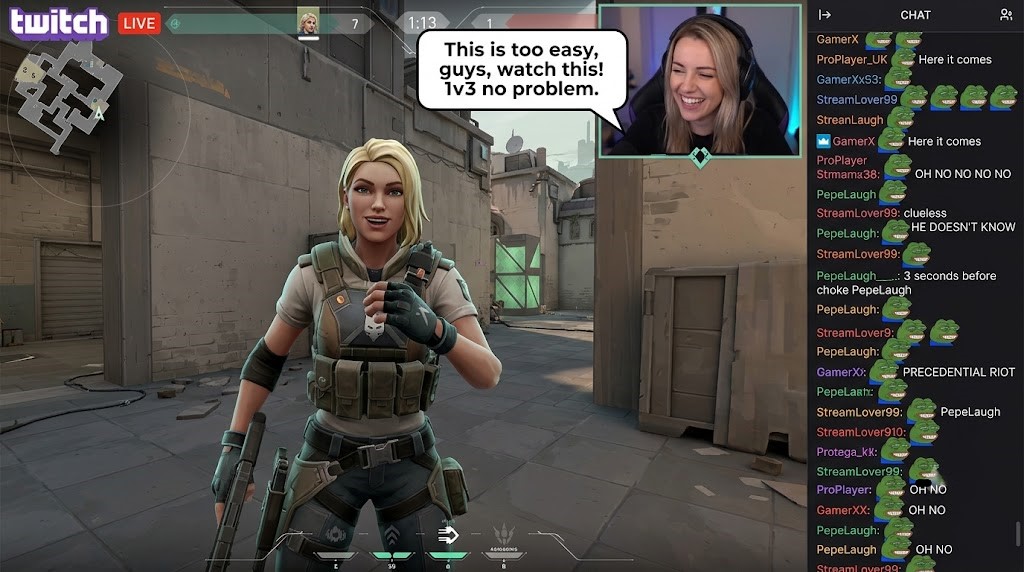
Open any Twitch stream during a clutch moment and chat will be wall-to-wall with this emote. Not because something funny already happened. Because everyone knows something funny is about to happen. That’s the whole point. It’s not laughter at a joke. It’s laughter at fate.
The image shows Pepe the Frog with a massive grin and teary eyes, like he’s laughing so hard he’s crying. But the real magic is in how it’s used. Drop it when a streamer is walking into an obvious trap. Spam it when someone confidently says “I got this” right before whiffing. Pair it with “Here it comes” and you’ve got Twitch chat’s favorite prediction engine.
How It Became a Thing
The image itself comes from Matt Furie’s Pepe the Frog comic, Boy’s Club, originally published in 2005. The specific laughing variant first surfaced on 4chan’s /pol/ board on August 13, 2014, because of course it did. From there it got uploaded to FrankerFaceZ on November 14, 2015, and later to BetterTTV in December 2017.
But it didn’t blow up until Forsen’s community got their hands on it. Forsen, a Swedish streamer known for Hearthstone and variety content, had a chat culture that basically weaponized every Pepe variant. His viewers started spamming it alongside the phrase “Here it comes” whenever the streamer was clearly about to mess something up. By February 2019, over 1,300 channels had adopted it through BetterTTV alone. Today it’s enabled on more than 64,000 channels.
The “Here it comes” pairing is what separates this from regular LUL or KEKW. Those react to something that already happened. This one predicts. It’s the equivalent of watching someone about to walk into a glass door. You know. They don’t. The emote bridges that gap.
PepeLaugh in the Wild
Over in Twitch chat:
Streamer: “I’m definitely not walking into that trap”
chat: PepeLaugh
chat: Here it comes
chat: OH NO NO NO
streamer walks into trap
chat: PepeLaugh PepeLaugh PepeLaugh
The anticipation is the joke. By the time the actual fail happens, chat has already moved on to predicting the next one.
Or the classic “HE DOESN’T KNOW” variant:
chat: PepeLaugh
chat: HE DOESN’T KNOW
chat: he lacks critical information
streamer: “What? Why are you spamming?”
chat: PepeLaugh
This one’s especially brutal because the streamer can’t even see the emote without BTTV/FFZ installed. They’re getting roasted by an audience they can’t fully perceive. Beautiful.
Why Everyone Says PepeLaugh
It fills a niche that no native Twitch emote quite captures. LUL is for funny moments. KEKW is for absurdity. OMEGALUL is for when something is so bad it’s good. This one is for the moment before the moment. It’s schadenfreude with a countdown timer.
The Pepe connection also matters. Pepe the Frog has become the unofficial mascot of Twitch culture. MonkaS for anxiety, PepeHands for sadness, Pepega for stupidity, and this one for the sweet joy of watching someone else’s impending doom. The frog does it all.
Tbh I still spam it unironically when my friends say they’re “just gonna peek this angle real quick.” We all know how that ends.
FAQ
Is this the same as LUL?
Nah. LUL is a reaction to something already funny. This is preemptive. It’s for when you see the setup and the punchline hasn’t landed yet. Also LUL is an official Twitch emote. This one needs BTTV or FrankerFaceZ to show up. If you type it without extensions, you just look like you’re yelling into the void.
Why do people say “Here it comes” with it?
Because Forsen’s chat made it a thing, and Forsen’s chat makes everything a thing. The phrase signals that the streamer is walking into a predictable disaster. It’s half warning, half celebration. The streamer almost never reads it in time to actually avoid the disaster, which just makes it funnier.
Can I use it outside Twitch?
Yeah, it’s spread to Discord and Twitter. Anywhere gamers gather, you’ll find it. Though it loses some power outside of live context. It works best when there’s real-time suspense.
How do I explain this to someone who doesn’t use Twitch?
Show them the crying-laugh emoji, then explain it’s that but with a sense of impending doom. It’s what you send when you see someone about to make a mistake so obvious that laughing is the only appropriate response.