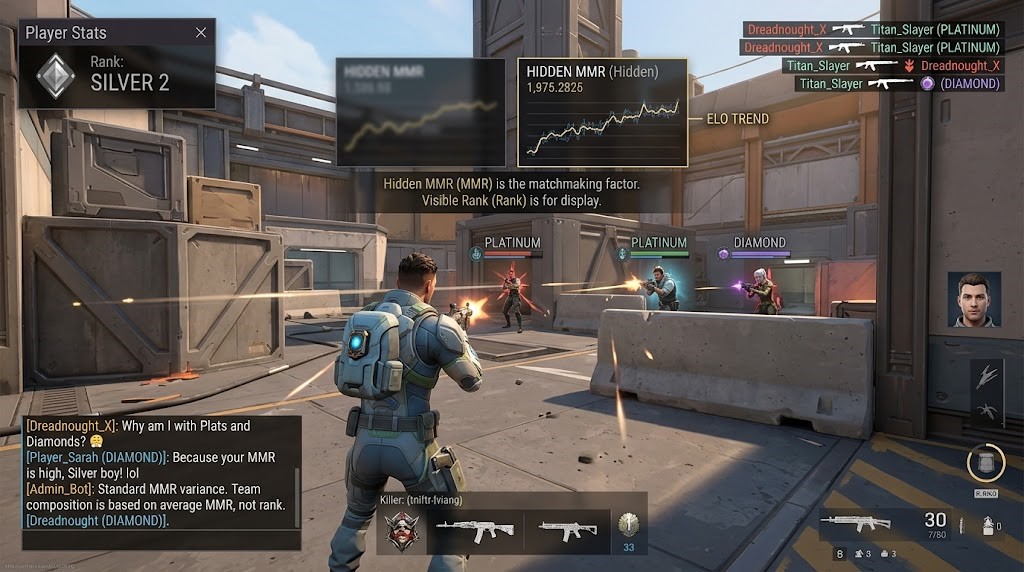
On paper, it just means Matchmaking Rating. In practice, it’s the invisible hand that decides whether your teammates are gods or griefers. You can’t see it. You can’t touch it. But it controls your life.
Every ranked player has a story about this number. The account that placed too low. The win streak that suddenly matches you against pros. The friend who swears the system is rigged because he got one bad team three times in a row. It’s the ghost in the machine, and we all blame it for our losses.
What It Sounds Like In-Game
Teammate: “How are we getting these lobbies?” You: “My hidden rating is tanked from last season.” Teammate: “Visible rank means nothing, huh?” You: “Means absolutely nothing. We’re in Elo hell’s waiting room.”
That conversation happens ten thousand times a day. This score is the secret number behind your shiny badge. You might be Gold on screen, but if your hidden rating is Diamond, you’re playing Diamond lobbies. If it’s Silver, welcome to the jungle.
Where It Came From
The concept comes from the Elo rating system, invented by Arpad Elo for chess in the 1960s. It was designed to measure player skill mathematically. Win against a stronger opponent? Your rating jumps. Lose to a weaker one? It tanks.
Video games adopted it in the late ’90s. StarCraft and Warcraft III used early versions. By the time League of Legends launched in 2009, “MMR” was standard vocabulary. Riot made it hidden to reduce anxiety. It didn’t work. We just got anxious about the number we couldn’t see.
Today, virtually every competitive game uses some form of it. Dota 2, Valorant, Overwatch, Rainbow Six—same idea, different algorithms. Some call it SBMM (skill-based matchmaking). Some call it hidden rank. Gamers call it by this acronym and complain about it constantly.
The Effect
This system creates a specific kind of paranoia. Since you can’t see it, you invent explanations. “The system wants me at 50% win rate.” “I’m getting matched with smurfs because my hidden rating is too high.” “I need to derank to climb easier.” Most of this is copium. Some of it is true. The fun part is figuring out which is which.
| What you see | What the system actually does |
|---|---|
| Your rank badge | Cosmetic tier, updated slowly |
| Your hidden score | Real skill estimate, changes fast |
| Ranked LP | Buffer between the two |
| Promos | Ritual to make climbing feel meaningful |
Pro players talk about it differently. For them, it’s a tool. A high rating means faster queue times and better practice. For the rest of us, it’s a conspiracy theory with math.
Honestly, I check third-party MMR estimators after every loss streak. It’s unhealthy and I can’t stop.
FAQ
Is this the same as rank?
Nope. Rank is what they show you. This is what they actually use. You can be Gold with Diamond-level hidden score, or Diamond with Gold-level score. The system matches based on the hidden number, not the badge.
Can I see my score?
Most games hide it. Some third-party sites estimate it for games like Dota 2. Riot has explicitly said they won’t show it in League because it would make toxicity worse. They’re probably right.
How do I explain this to a non-gamer?
It’s like a restaurant that seats you based on your cooking skill, not your apron color. The apron (rank) might say “Chef,” but if you burn toast, they’re putting you with other toast-burners until you improve.
Why do gamers blame this for everything?
Because it’s invisible and convenient. You can’t prove it’s wrong, and it feels good to have a villain. The algorithm is the perfect scapegoat.