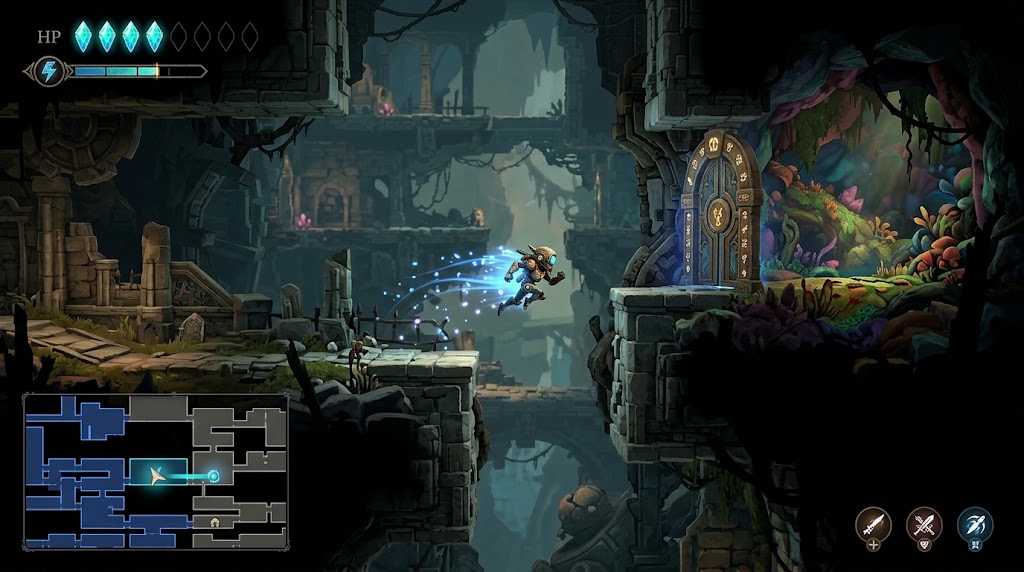
The first time someone said metroidvania to me, I nodded like I understood. I didn’t. I pictured a budget console from a country I couldn’t place. Took me an embarrassing number of years to learn it’s just two game titles welded together, and the weld holds up better than most genres invented on purpose.
How Metroidvania Took Over Gaming
Walk through Steam’s indie section and the tag is everywhere. Hollow Knight turned the formula into a religion, and now every second pixel-art adventure promises “a vast interconnected world” in the trailer. The speedrun crowd loves these games because routing is the whole puzzle (wrong door, lose four minutes). The word went from forum shorthand to an actual storefront category, which almost never happens with mashed-up portmanteaus. Usually they die in the thread that births them. Why do gamers say metroidvania instead of “exploration platformer”? It’s shorter, and Hollow Knight made it cool.
How We Got Here
The metroidvania origin story is a weld: Smash Metroid and Castlevania together and there’s your word. If you’re wondering what metroidvania means in plain terms: one big interconnected map, gated by abilities instead of keys. It started on forums in the early 2000s as shorthand for what Castlevania: Symphony of the Night borrowed from Super Metroid. Japan never adopted the label (they call the style “search action”), and a brief 2006 push to rename the genre “Castleroid” deservedly went nowhere. These days it sits in Merriam-Webster’s slang dictionary, so the forums officially won that one.
Quick test for beginners: if a power-up only raises your damage, it’s an upgrade, not a key. In the real deal, the new ability opens a route you physically couldn’t pass before. Double jump reaches the ledge. Dash breaks the wall. Upgrade and gate-opener in one package, or it’s just an action game with a nice map.
Metroidvania in Real Conversations
Metroidvania examples from actual debates and group chats.
Every “is this game a metroidvania” argument ever:
“the map loops back and you get a grappling hook, it counts” “the hook is a mobility upgrade, not a gate opener” “it opens the waterfall cave” “ONE cave” That thread is still going, by the way. Four hundred replies deep.
Group chat, someone needs a palette cleanser after ninety hours of an open-world RPG:
“something short. no map markers. no crafting” “hollow knight” “the bug one?” “you’ll know the bench mechanic when you see it”
Reddit, weekly hidden-gems thread:
“picked up that new indie metroidvania on sale” “which one, there’s like forty” “the one with the owl” “that narrows it to six”
Common Questions
Metroidvania vs soulslike: where’s the line?
Different questions entirely. A soulslike is about punishing combat and losing your currency when you die. This label is about the map: abilities as keys, backtracking with new powers. Hollow Knight borrows from both, which is why people mash them together. A game can wear either hat alone, though.
What makes a game count as one?
Run the ability test. Does a new power open a path you couldn’t physically pass before? Double jump reaching a ledge counts. A sword with +10 damage doesn’t. If progress is gated by abilities instead of story flags, you’re in. Everything else is set dressing. Ask “what does metroidvania mean” and the shortest honest answer is: abilities as keys.
Did the word ever escape gaming forums?
Yes and no. It’s in Merriam-Webster’s slang dictionary and storefronts use it as an official tag. Your non-gaming friends still won’t know it, so just say “a 2D game where you unlock the map as you get stronger” and watch them nod. Any side quest enjoyer will get it instantly.