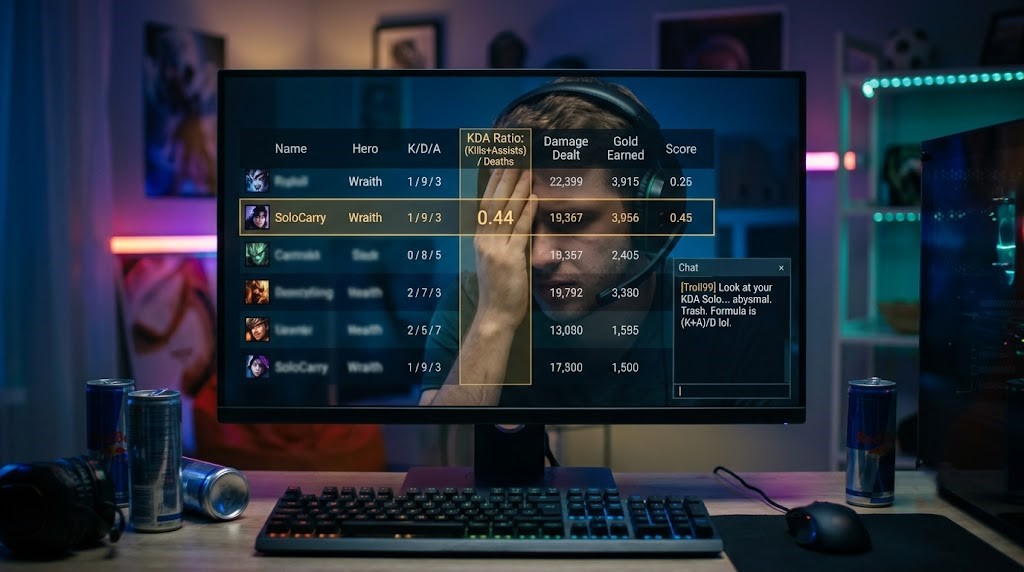
Every new player learns KDA the hard way. Mine was a 2/11/6 game where our midlaner typed my score into all-chat like he was reading out a court verdict.
More Than Just a Word
KDA stopped being a stat a long time ago. It’s an identity now. Players apologize for it, hide behind it, weaponize it. “Look at your KDA” has ended more lobby arguments than any actual replay review, mostly because it lets the arguer skip the replay entirely.
And then there’s the pop culture layer. In 2018, Riot took the acronym and turned it into a virtual K-pop group (POP/STARS, hundreds of millions of views). Your ranked stat and a girl group share three letters. Gaming is weird.
As a support main, I have complicated feelings about the number. My best game last season was 1/2/23 and somebody still flamed the 1. Cool system.
A Quick History of KDA
Where did KDA come from? Kill-to-death ratios have been tracked since the early arena shooter days, a quick way to answer “who’s actually doing work here.” When MOBAs took over, plain KD developed a problem: half the roster exists to help, not to kill. League of Legends normalized folding assists into the formula, and KDA, (Kills + Assists) ÷ Deaths, became the default report card across the genre.
The math quirks matter. Die zero times and the division breaks, so most games just hand you K+A as a flat “perfect” score. Go 10/3/1 and you’re sitting at 3.67. Broadcasts flash it, post-game lobbies argue about it, and the players who carry hardest aren’t always the ones sitting on top of it.
How Gamers Actually Use KDA
Post-game lobby, ranked:
Jungle: “mid diff, look at his KDA” Mid: “I have 11 assists??” Jungle: “2 and 9 is 2 and 9” Mid: “it’s 2 plus 11 divided by 9… okay that’s still bad.”
Every “is KDA a good stat” thread on Reddit, forever:
Top comment: “KDA measures participation, not impact.” Second comment: “cope, 0/10 Yasuo.”
Both are right. That’s the whole debate. Here’s the framework I use after years of watching scoreboards lie: KDA tells you how much you were around kills, not whether you won anyone the game. If you can’t point to one actual play you made, the number is decoration. A jungler who never ganks can sit on a clean 3/1/2 while losing every objective on the map.
One thing not to do: play FOR your KDA. Bailing out of a winnable fight to protect your ratio feels safe and loses games. The number should describe your game, not steer it.
FAQ
Is KDA the same as KD?
No. KD is just kills divided by deaths, the classic shooter stat. KDA adds assists into the numerator, which is why MOBAs use it. It gives credit to the players setting up kills instead of only the ones finishing them. Same family, different math.
What’s actually a good KDA?
Depends entirely on your role. Around 3.0 is solid for most positions. Supports live on assists, so their ratios look different from a carry’s, and that’s fine. The honest answer: if your win rate is climbing, your KDA is good enough. Every noob obsesses over the ratio. Veterans obsess over the W.
Is KDA the same as that K-pop group?
Same letters, different universe. K/DA the band is Riot’s virtual pop group from 2018, named after the in-game term. If someone says “KDA” during a match, they mean your stats. If they say it while linking a music video, they don’t.