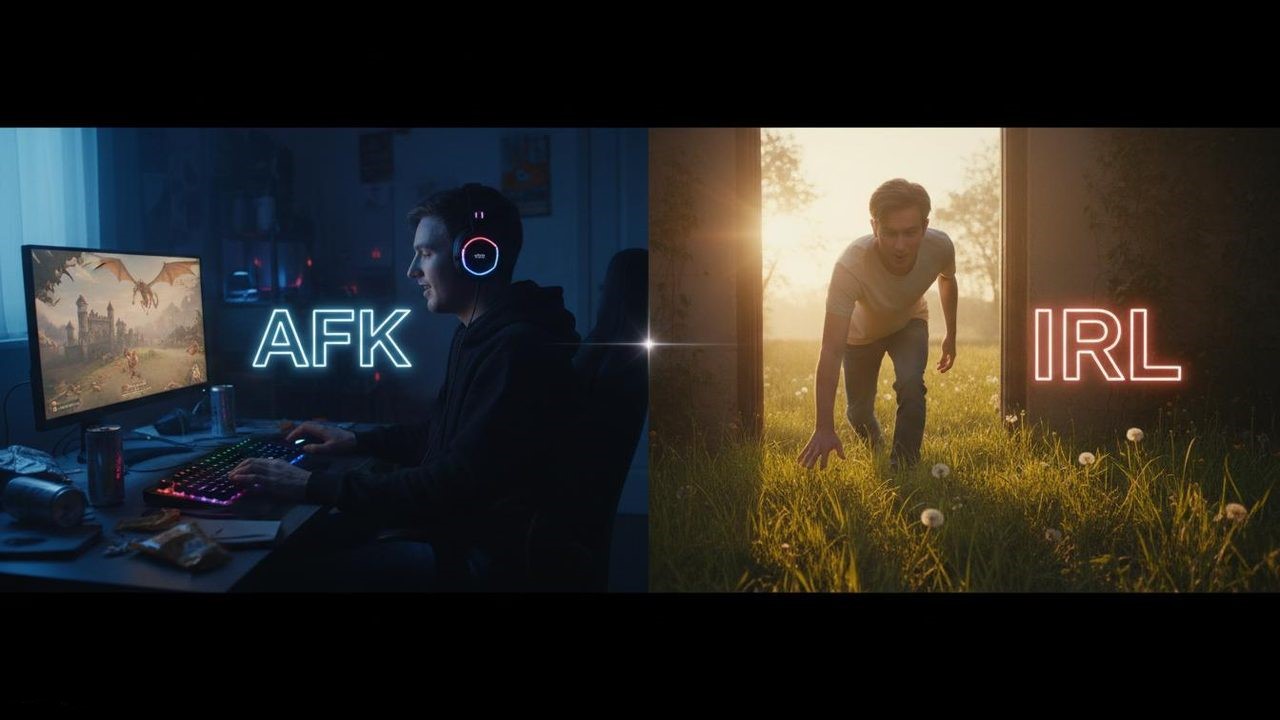
In gaming, IRL stands for In Real Life — used to distinguish between the game world and the physical world. Common in streaming and online communities.
Trajectory & Chronology
IRL originated in early internet chatrooms and forums in the 1990s, where users needed to distinguish between online personas and real-world identities. It entered gaming through MMOs like World of Warcraft (2004), where players would say “IRL I’m a student” vs. “in-game I’m a raid leader.” Twitch popularized “IRL streaming” in 2016 — streamers broadcasting their daily lives rather than gaming. By 2026, IRL is standard vocabulary across all internet culture.
GEBILAOWANG: The older the internet slang, the more likely it is to have survived. IRL has been around since the 90s.
High-Fidelity Contextual Dialogues
Scene: Discord, making plans
Player A: “We should meet up IRL sometime” Player B: “For sure, I’m in NYC too”
Scene: Twitch chat
Streamer: “Going IRL for a bit, back to gaming later” Chat: “IRL stream Pog”
Scene: Friend comparison
Player A: “You’re so different IRL vs. in-game” Player B: “In-game I’m toxic, IRL I’m chill”
Socio-Cultural Gain
The distinction between IRL and in-game reflects how deeply gaming has integrated into modern social life. For many players, their online relationships and achievements are as meaningful as offline ones. The term IRL gained prominence during the streaming era, where broadcasters constantly juggle their on-screen persona with real-world responsibilities. In 2026, with the rise of virtual spaces and the metaverse, the line between ‘in real life’ and ‘in game’ continues to blur, making IRL an increasingly nuanced concept.
FAQ
Q1: Is IRL only for gaming?
No, it’s used across all internet culture to distinguish online from offline.
Q2: What’s an IRL stream?
A livestream of someone’s real-life activities, not gameplay.
Q3: Do gamers have different personalities IRL?
Sometimes. The anonymity of gaming can bring out different behaviors.