Socio-Cultural Gain
Inting sits at the toxic heart of competitive gaming. It’s not just “playing badly” — it’s the accusation that a teammate is throwing on purpose, which is one of the worst things you can say in a ranked lobby. That makes it both a description and a weapon: sometimes a player is genuinely griefing, and sometimes they’re just having a rough game and “stop inting” is the team’s way of venting.
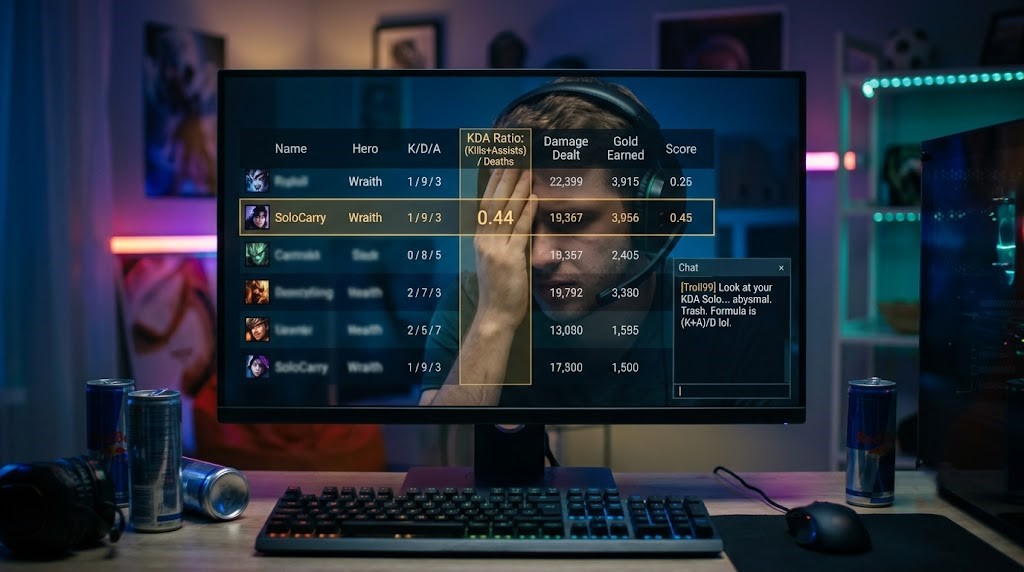
The term reveals how high the stakes feel in MOBAs. A single death feeds the enemy gold and XP, so one tilted teammate can mathematically sink four other people. “Inting” gives players a word for that specific betrayal — the difference between an honest mistake and sabotage. It’s also why “soft inting” exists: the gray zone where someone is clearly playing badly but you can’t prove they meant to. The word captures gaming’s eternal tension between “my teammate is bad” and “my teammate is evil.”
Trajectory & Chronology
Inting entered gaming through League of Legends, first as shorthand for “intentionally feeding” sometime in the early-to-mid 2010s. “Feeding” — dying repeatedly and handing the enemy free gold and experience — was already the community’s word for a disastrous performance. Adding “intentional” to it created a new, more serious charge: you weren’t just dying, you were dying on purpose to lose the game.
From League it spread to basically every team game with a shared economy — Dota 2, Overwatch, Valorant, even battle royales. Riot made inting a reportable offense, which only cemented the word’s importance; being accused of inting could literally get your account banned. Over time the meaning softened in casual use. Players now say “I’m inting” self-deprecatingly after a single dumb death, the same way people use “literally” for things that aren’t literal. But in a ranked game, “he’s inting” still carries the original sting — it’s a report, a flame, and a verdict all at once.
GEBILAOWANG: The funniest part is how fast “inting” became an excuse. Half the people screaming it are 0/5 themselves. It’s the gaming version of “it’s not me, it’s everyone else.”
High-Fidelity Contextual Dialogues
Ranked League lobby, all-chat after a death (heated):
“stop inting top, you’re 0/6 at 10 minutes” “I’m not inting, their jungler won’t leave my lane, chill”
Discord, watching a friend’s match (casual):
“Wait why did he walk into four people??” “Honestly that looked like soft inting, he’s been tilted since game one”
FAQ
Q1: Is “inting” the same as “feeding”? Feeding is the act — dying a lot and giving the enemy resources. Inting is feeding intentionally, with the goal of losing. All inting is feeding, but not all feeding is inting. A new player feeding because they’re bad isn’t inting; someone running it down mid on purpose is.
Q2: What’s the difference between “soft inting” and “hard inting”? Hard inting is obvious, deliberate griefing — repeatedly dying on purpose, ignoring objectives, actively trying to lose. Soft inting is the subtle version: bad positioning, ignored pings, questionable decisions that hurt the team without clear proof of intent. Hard inting gets you banned fast; soft inting is harder to punish because it can look like a genuine bad game.
Q3: Is “inting” still used in 2026? Constantly. It’s permanent League vocabulary and shows up in every team game. If anything it’s more common now because players use it loosely to mean “playing badly” even when nobody’s actually griefing.
Q4: How do you explain “inting” to a non-gamer? It’s like a soccer player deliberately scoring own goals to make their team lose. In a game, that means dying on purpose so the enemy gets stronger. The word is short for “intentionally feeding,” and accusing someone of it is a serious insult.