On paper, it just means two different things depending on who you’re talking to. In practice, it’s the difference between feeling like you’re playing in butter versus feeling like your mouse is an extension of your hand. Gamers use it to describe both the genre (first-person shooter) and the performance metric (frames per second), and honestly? Both meanings matter way more than most people realize.
If you’re in a lobby and someone asks “what do you play?” they probably mean the genre, Call of Duty, Valorant, CS2, that whole family. But if someone says “my frames are terrible” mid-match, they’re talking about performance. Same acronym, completely different conversation. You kind of just learn to read the room.
The Effect
Frame rate isn’t just a number. It’s the entire feel of a game. At 30, you’re seeing 30 individual images per second. Playable? Sure. Smooth? Not even close. Bump that to 60 and everything starts feeling natural. Hit 144 or 240 and suddenly you’re tracking enemies better, reacting faster, landing shots that felt impossible before.
Competitive players will sacrifice every graphical bell and whistle for higher frame rates. Shadows? Off. Textures? Low. Particle effects? Gone. They’d rather play a game that looks like a potato if it means their crosshair moves exactly when their hand does. And they’re not wrong, studies consistently show that higher frame rates improve reaction times and aiming accuracy in fast-paced games.
The genre side is equally important. First-person shooters dominate esports for a reason. The skill ceiling is infinite. There’s always a better flick, a faster peek, a smarter angle. Games like Counter-Strike have been around for decades and people are still discovering new techniques. That’s the genre in a nutshell, simple to learn, physically impossible to truly master.
A Quick History of FPS
The genre basically started with Doom and Quake in the ’90s. Before that, shooters existed but they were slow, tactical, methodical. id Software changed everything by making speed the point. Strafe-jumping, rocket jumping, bunny hopping, these weren’t bugs, they became features. The community found ways to move faster than the developers intended, and instead of patching them out, competitive play embraced them.
Frame rate as a concern grew alongside the genre. Early console shooters were locked at 30 and nobody complained because we didn’t know better. Then PC gaming pushed higher refresh rates, and once you’ve played at 144Hz, going back feels like someone’s added input delay to your entire life. Monitors kept improving, 240Hz, 360Hz, even 500Hz panels now, and each step makes a real difference at the highest levels of play.
The two meanings actually intersect in interesting ways. A shooter running at low frames is basically unplayable competitively. The genre demands the metric. You can’t have serious CS2 at 30. It’s like trying to play piano with oven mitts.
What It Sounds Like In-Game
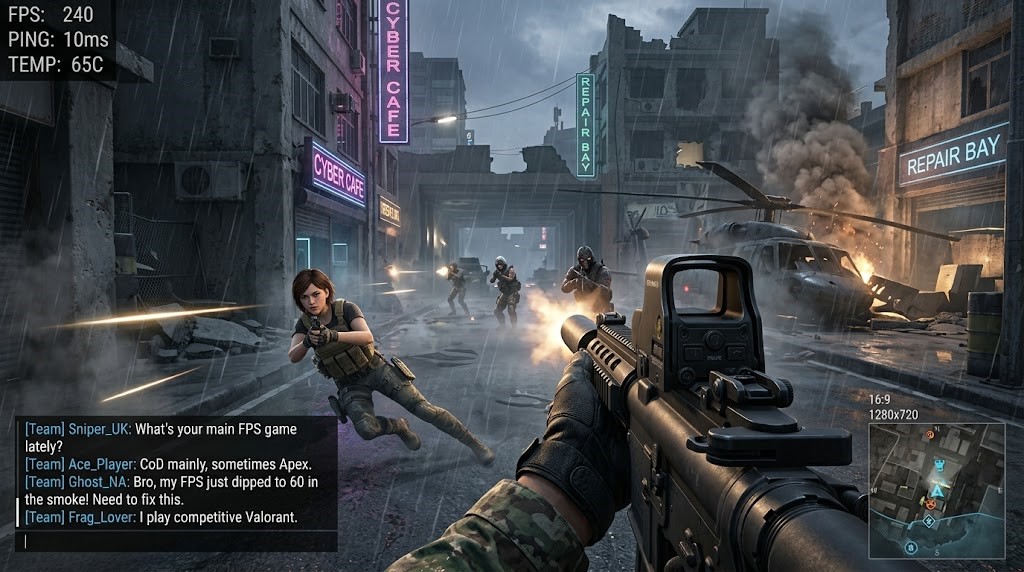
teammate: “What frames you getting?”
you: “Like 200, but it drops to 80 in smokes”
teammate: “Yeah that’s rough. Cap it at 144 so it’s stable.”
you: “Good call.”
Or the genre conversation:
friend: “You play any shooters?”
you: “Mostly Valorant and some Apex”
friend: “Nice, I’m trying to get into CS2 but the recoil is brutal”
you: “It’ll click after like 100 hours. Or 500. No one really knows.”
Tbh I used to think 60 was fine until I tried 144. Now I can’t go back. It’s one of those things you don’t notice until you do, and then you can’t unsee it. Like a scratch on your monitor that you keep trying to wipe off.
A quick comparison that actually matters:
| Aspect | Genre | Frame Rate | |