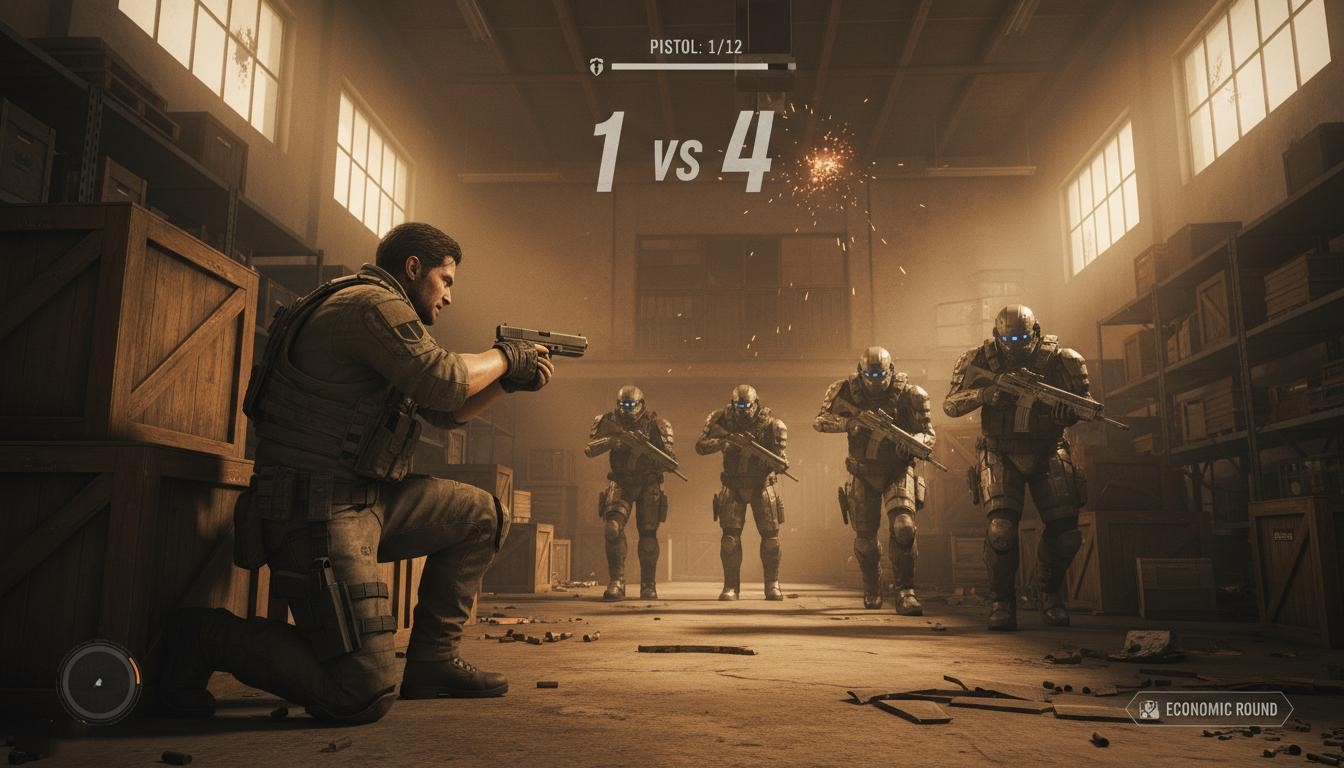
In gaming, eco is short for “economy round” — a round where a team intentionally buys little or no equipment to save money for future full-buy rounds. The art of losing now to win later.
Trajectory & Chronology
The term eco originated in Counter-Strike (1999), where teams would do “eco rounds” — buying only pistols or nothing at all — to save enough money for rifles in subsequent rounds. The concept became fundamental to tactical shooters and spread to games like VALORANT (2020). By the 2010s, “eco” was standard vocabulary in any game with an economy system. The strategy evolved from simple money-saving to complex mind games — a well-played eco round could steal a round from a full-buy team. In 2026, eco rounds are a core strategic element of competitive shooters.
GEBILAOWANG: A good eco round isn’t about losing gracefully. It’s about taking the enemy by surprise and stealing a round you have no business winning.
High-Fidelity Contextual Dialogues
Scene: Team discussion
Player A: “We’re broke, we need to eco” Player B: “I’ll buy armor and a pistol, that’s it” Player A: “If we win this eco, we break their economy” Player B: “And if we lose, we full buy next round. Either way, it’s the right call.”
Scene: After a failed full buy
Player A: “Why did we force buy last round? Now we’re on eco” Player B: “I thought we could win” Player A: “We had $1500 each. Against their full buy. We threw our economy.”
Scene: Winning an eco round
Player A: “WE WON THE ECO!” Player B: “HOW?!” Player A: “Rush B, they didn’t expect it. Pistol headshots everywhere” Player B: “That just won us the game. Their economy is broken now.”
Socio-Cultural Gain
Eco rounds represent one of gaming’s most interesting strategic concepts — accepting short-term loss for long-term gain. This philosophy extends beyond gaming into broader life lessons about patience and resource management. In competitive play, eco rounds create dramatic moments where underdogs defeat fully-equipped opponents through superior tactics rather than gear. The “force buy vs. eco” debate — whether to buy what you can afford or save for a full buy — is one of competitive gaming’s most enduring strategic discussions. Professional teams have coaches specifically for economy management, recognizing that money management wins games as much as mechanical skill.
Force buy — Buying what you can afford rather than saving, hoping to catch the enemy off guard. Full buy — A round where the team has enough money for rifles, armor, and utility. Anti-eco — When a team expects an eco round and plays cautiously to avoid being surprised.
FAQ
Q1: When should we eco?
A: When the team collectively can’t afford rifles + armor + utility. The goal is to have everyone full buy in 1-2 rounds.
Q2: Can you win an eco round?
A: Yes, about 15-20% of the time in professional play. Aggressive, unexpected strategies work best since the enemy expects you to be passive.
Q3: What’s the difference between eco and force buy?
A: Eco = minimal spending, saving for future. Force buy = spending everything you have now, hoping to win despite inferior equipment.