Socio-Cultural Gain
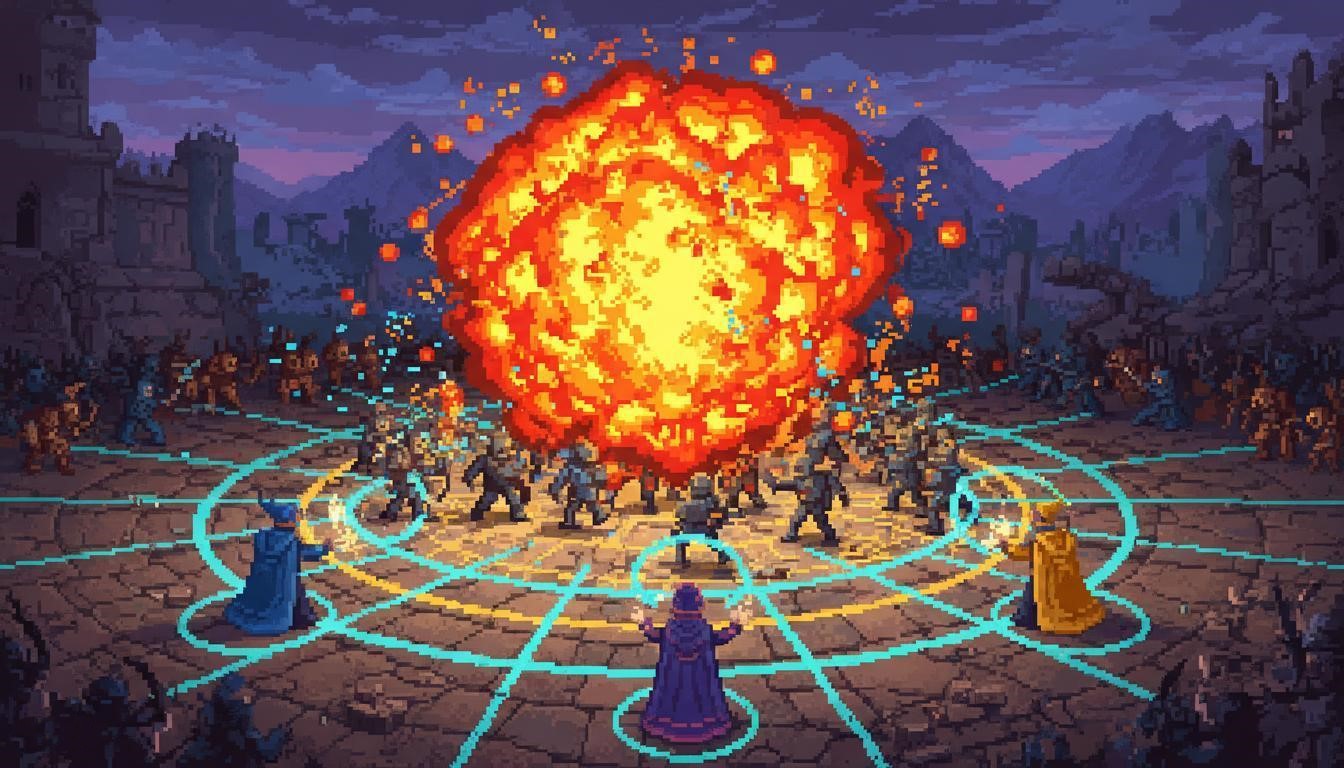
AoE isn’t just a technical term — it’s the foundation of modern team-based combat design. Before AoE became standard, most game attacks hit single targets. The introduction of area-based effects fundamentally changed how developers designed encounters and how players thought about positioning. A well-placed AoE can win a team fight; a poorly placed one can wipe your own squad.
In gaming culture, “AoE” functions as both noun and verb. Players say “that mage has crazy AoE” (noun) and “don’t stand there, they’re going to AoE” (verb). This linguistic flexibility reflects how deeply embedded the concept is in gaming vocabulary. It’s one of those terms that newer players learn quickly because understanding AoE is literally a survival skill in most multiplayer games.
The term also represents one of gaming’s most satisfying power fantasies. Single-target damage feels precise and skilled, but AoE damage feels explosive and dominant. There’s a specific dopamine hit from watching a fireball or ultimate ability hit five enemies at once — game designers specifically engineer this moment because it’s one of the most rewarding experiences in gaming. The “wombo combo” (chaining multiple AoE abilities together) is considered the peak of team coordination in MOBAs.
High-Fidelity Contextual Dialogues
Scene: League of Legends team fight
Top: “Their team is grouped, perfect for my ult” Support: “Wait for my engage, then drop the AoE” Jungle: “I’m ready, hit them” Support lands a 4-man stun Top: “AOOOEEEEE” Ultimate hits all four enemies Team: “WOMBO COMBO”
Scene: World of Warcraft raid, boss encounter
Raid Leader: “Red circle on the ground, MOVE OUT” Player1: “That’s the AoE, don’t stand in it” Player2: “I got hit by it” Raid Leader: “Player2 please install DBM, I can’t call every AoE” Player2: “sorry first raid”
Scene: Valorant, post-round analysis
Player1: “Why did you throw your molly at one person?” Player2: “I panicked” Player1: “That’s an AoE ability, use it when they’re grouped at a choke” Player2: “noted” Player1: “AoE = Area of Effect, not Area of One Person”
Scene: Discord, discussing game design
Alex: “What’s the most satisfying sound in gaming?” Jordan: “Definitely hitting a 5-man AoE ult in League” Sam: “Nah, it’s the Overwatch Genji deflect sound” Jordan: “Okay what’s the SECOND most satisfying sound?” Alex: “A 5-man AoE ult”
Trajectory & Chronology
The concept of Area of Effect originated in tabletop role-playing games, particularly Dungeons & Dragons in the 1970s. Spells like Fireball had explicit area dimensions — “a 20-foot radius sphere” — which meant the Dungeon Master had to track which miniatures were inside the blast zone. This created tactical depth around positioning that became a defining feature of the genre.
When video game RPGs emerged in the 1980s and 1990s (Ultima, Baldur’s Gate, Diablo), AoE mechanics were natural fits. Diablo’s sorceress class built its entire identity around area spells — Firewall, Blizzard, and Meteor became iconic abilities specifically because of their area coverage. The visual feedback of watching multiple enemies die simultaneously was deeply satisfying and became a core part of the action RPG formula.
The term “AoE” as specific slang crystallized in the early 2000s with MMORPGs like EverQuest and World of Warcraft. In WoW, raid encounters were designed around AoE mechanics — players had to “spread out” for some abilities and “stack up” for others. Raid leaders calling “AoE incoming” became standard vocabulary. The abbreviation was faster to type than “area of effect” during intense combat, and it stuck.
MOBAs (starting with Defense of the Ancients in 2003, then League of Legends in 2009) took AoE to new heights. In MOBAs, landing a multi-person AoE ability is the difference between winning and losing team fights. The term became so central to MOBA strategy that “AoE comp” (a team composition built around area abilities) became a recognized strategy archetype.
By 2026, AoE is universal across gaming genres. Battle royales have AoE grenades and airstrikes. FPS games have explosive weapons. Even fighting games have moves with hitboxes large enough to function as pseudo-AoE. The concept has become so fundamental that most players don’t even think of it as slang — it’s just how games work.
GEBILAOWANG: AoE is proof that gamers will abbreviate literally anything. “Area of Effect” is already short, but we still needed three letters.
FAQ
Q1: What’s the difference between AoE and DoT?
AoE (Area of Effect) describes HOW MANY targets you hit — multiple enemies in an area. DoT (Damage over Time) describes WHEN the damage happens — gradually over seconds instead of instantly. An ability can be both AoE and DoT (like a poison cloud that damages multiple enemies over time), or just one or the other. Single-target DoT is just DoT. Instant multi-target damage is just AoE.
Q2: Why is positioning so important for AoE?
Because AoE effectiveness is entirely dependent on enemy grouping. An AoE ability that hits five enemies is five times more valuable than the same ability hitting one enemy. Good players position themselves to maximize AoE coverage — either by waiting for enemies to group naturally or by using crowd control to force them together. Bad players waste AoE abilities on single targets or miss entirely because they didn’t account for enemy spacing.
Q3: Is AoE only for damage?
Not at all. While damage is the most common AoE effect, many games have AoE healing (restoring health to allies in an area), AoE buffs (boosting stats for teammates nearby), and AoE crowd control (stuns, slows, or roots affecting multiple enemies). In World of Warcraft, some of the most important AoE abilities are healing spells that keep the raid alive during massive damage phases. In MOBAs, AoE shields and speed boosts can be just as fight-winning as AoE damage.
Q4: How do you explain AoE to a non-gamer?
“In video games, some attacks hit a single target while others hit everything in an area — like a fireball explosion versus a single arrow. AoE stands for ‘Area of Effect’ and it means the attack affects a whole zone rather than one enemy. It’s like the difference between shooting one person with a pistol and throwing a grenade that hits everyone nearby.”